Decoding the Torah through the “Language of Birds”: From Adam to the Levite-Alevis
(Translated into English with the help of ChatGPT)
Today, religions around the world are beginning to lose their relevance. The main reason for this lies in the fact that the true essence of the Holy Scriptures has not been revealed. The absence of logical explanations of the sacred texts has led many believers to doubt their own faith, which grieves the righteous. Yet this is no reason for despair. On the contrary, trusting in God, believers must continue seeking Him. This article is dedicated to those who continue to hope and await God.
In the previous article, “Decoding the Torah through the ‘Language of Birds’: With Whom Did Jacob Wrestle?”, we demonstrated the logic of the ancient sages by which the Biblical texts can be understood (1). This logic of the ancients is known as Sufi-batinism, Shi‘ite esotericism, and similar traditions. In this present work, we will apply the same logic to decipher the most mysterious tribe of the Israelites—the tribe of the Levites. Yet in order to fully grasp the essence of these texts, we must begin with the creation of the world.
The Torah (Torah) opens with the creation of heaven and earth by God. In the book “The Book of Horus, or the Decoding of the Torah”, we showed that the symbols of “heaven and earth” in the sources actually refer to the heavenly world in which the ancient Egyptian Pharaoh (Pir) Amon, through theurgy, created the kingdom of the spirits—Geb (2). In seven stages, Pir Amon brought forth Adam and the Garden of Eden in the East.
According to the Torah, when Adam was created, he was of cosmic proportions—stretching “from one end of heaven to the other” (3). In ancient Egyptian texts, the symbols Adam/Eden (DM) are written as the god Atum (TM), the deity who creates himself out of primordial matter. Atum, who consists of nine emanations (the Nine Gods of the Ennead), personifies primordial matter, embracing all that exists. In the mystical-allegorical commentary on the Torah known as the Zohar (Kabbalah), this supreme cosmic deity is called Adam Elyon.
This totality is the divine emanation of Elyah, who, after the command of God—“Let the waters under the heavens be gathered into one place”—was gathered and “clothed” in the form of man. In esoteric interpretation, the symbol of “waters” refers to the Torah itself—that is, the ecstatic state of the theurgist, who at the Sufi stage of Baqa (symbolized by Jacob) attains unity with primordial matter and acts in its name. The “one place” signifies Adam/Atum (Jacob), the theurgic process of Baqa carried out by Pharaoh Amon.
The process of Baqa unfolds in the mind, in the intellect of the Creator, which is called Ba (the sefirah Binah). Therefore, when God said, “Let the waters be gathered into one place,” we must envision the process of primordial matter being drawn together through theurgy into the form of Adam. Thus, Adam/Atum is the cosmic Man, manifested from primordial matter, upon whose “body” the Garden of Eden was formed.
In Shi‘ite esotericism, the world of Eden—created in six days—is also called El-Om, and like Jerusalem, it exists upon the body of the cosmic Adam (4). The same idea is expressed by the Turkic Khagans in the inscriptions of Moyun Chor, Bilge-Khagan, and Kül-Tegin. According to these texts, the Khagan “was in God,” meaning that having known the primordial matter, he transformed it into El. In ancient Assyria, this cosmic Man was called Lugal. The symbol of Lugal in Sufism, like the symbol of Allah, means Ilah-El—the heavenly world El, created from the primordial matter Ilah/Eloah.
Therefore, Adam is the cosmic luminous Man-God, whom Shi‘ite esotericists call Haq—that is, Allah (4).
In the Torah it is written that from the rib of Adam, God created his wife—Eve—who was also made in the image and likeness of God. According to Philo of Alexandria, God created two kinds of humans: heavenly and earthly. The heavenly ones are sealed with the image of God, while the earthly man was formed from the dust. Plato, on the other hand, teaches that the first humans were created by the Demiurge Himself, and therefore they are immortal. Ordinary mortals, however, He entrusted to those whom He Himself had already created (5). According to the sources, earthly men are governed by animal forces and are therefore unworthy of mention in the sacred texts. Thus, in all the sources, the references concern only the heavenly humans—those created in the image and likeness of God, who are immortal.
According to A. Oppenheim, the heavenly people are none other than the dynasty of the Gutians of Mesopotamia, whose dominion begins in the mythical age “when kingship descended from heaven to earth.” In Arabic sources, these heavenly men are called the Iranian population of Salman ibn Rabīʿ and others (6).
All this points to the fact that in the Torah, Adam is the cosmic God-Man, created by Pharaoh/Pir Amon. The symbol of Eve, in turn, signifies the immortal heavenly people, to whom God gave the command: “Have dominion over the fish of the sea, and over the birds of the heavens, and over every living creature that creeps upon the earth.” Thus, God created the heavenly humans for the governance of the world. In our books and articles we have already demonstrated that these heavenly people are the Platonic philosopher-kings, to whom was given the mysterious “language of birds.”
According to the Torah, after Adam “knew” Eve, two sons were born of them—Cain and Abel. They each brought offerings to God: the fruits of the earth and the firstborn of the flock. God accepted Abel’s sacrifice, and then Cain killed his brother.
In the article “The Truth about the Israelite Kingdom” we noted that the symbol of Abel is interpreted by the ancient sages as Va/Ba-El—that is, the spiritual world of Va/Ba. In ancient Egyptian texts, the divine soul Ba (Va) was represented as the bird Benu (Van), and the realm of these spirits was called El-Benu/Van—that is, Alban, Lebanon (7). The symbol of Cain, on the other hand, is one of the variants of Knun/Kinun/Nunki, and so on. These symbols in the sources are connected with the ziggurat Etemenanki (Atum-Nunki)—the city that the Sumerians called Nun-Ki (“the dwelling place of Nun”), known to us as Babylon and Eridu. “Babylon” literally means “the Gate of God”—the place where the doorway opens into the heavenly world of spirits, into El-Benu—Albania, the East. Thus, Cain is the symbol of the gate to this cosmic God-Man Atum.
According to the Torah, after the construction of the Tower of Babel, God confused the one language of the first people, who had come from the East, and scattered them across the whole earth. Henry Corbin, in his work “The Man of Light in Iranian Sufism”, emphasizes that under the symbol of the East, the Sufis meant the heavens—the celestial world. The entire luminous philosophy of the great Sufi Shihab al-Din Yahya Suhrawardi is dedicated to the search for this heavenly East (6). Therefore, the “first people who came from the East” must be understood as the mysterious Abelites—that is, the Albanians.
According to the logic of the ancient sages, the symbol Abel (VL) is identical in meaning to the symbol Levi (LV). We know that Levi was the third son of Jacob (Israel) by his wife Leah, and he is considered the forefather of the Levites and the Kohanim. Among the twelve tribes, God chose the Levites to serve Him, and they were the warriors of faith.
The symbol of Leah is the symbol of El—that is, the cosmic God-Man. The image of Jacob, in turn, is the image of the ecstatic state of Pharaoh Amon. Therefore, the Levites are those heavenly people who were created in the image and likeness of the God-Man Adam/Atum. And the fact that Leah is the daughter of Laban means that these people are connected with Albania (Lebanon/Levi).
On the other hand, the Levites are also understood as the priestly Kohanim, who descended exclusively from the line of Aaron through the male lineage. They guarded the Ark of the Covenant, stood before the Lord, served Him, and blessed in His Name. As it is written: “The Levite shall have no portion or inheritance with his brothers: the Lord Himself is his portion.” (9). Thus, in order to understand more about the Levi–Levites, we must fully decode the symbol of Aaron.
In ancient sources, the symbol Aaron appears as Aron/Aran/Eran/Eren (RN), Aharon/Harun/Haran (HRN), and so forth. In the epic Kitabi-Dede Gorgud, to the symbol Eren are added Evren and Bek—meaning “Hebrew Eren,” “Bek Eren,” and so on. According to this book, the lords of the ancient world were precisely these Bek-Eren (10).
The symbol Aron in the sources is most often written as Aran and refers to the Albanian royal lineage of the Aranshah. It is known that the rulers of Sisak–Gelarkuni later bore the dynastic title Aranshah, meaning “the Shahs of Aran/Eren/Iran.” The title Aran-shah is also connected with the land of Aran (Haran/Harran) and indicates the descent of the Syunik (Sina/Zion) princes from the dynasty of the Albanian king Aran (9). In his History of Armenia, Movses Khorenatsi presents the body of Aran as a heavenly land, noting that the lineage of Aran is the lineage of Sisak (9). Elsewhere, he names the House of Aran the Gelarkuni—the lineage of Sisakan.
The symbol Sisakan [SSKN] is identical with the symbol Shekhinah [SKN]—the Tabernacle of Divine Revelation. We know that after the construction of the Tabernacle, the Lord revealed Himself in the cloud that covered the Tent of Meeting, and the Glory of God filled it (11). Thus, Gelarkuni is the place where the Shekhinah was manifested—that is, the Tent formed of primordial matter. And the fact that in the texts the lineage of the Bek of Gelarkuni is called Sisakan means that upon these people the Deity manifested; they were created of divine fire and became the “vessel” (the Shekhinah) for receiving the Divine Light. This shows that the image of Aran is the image of the cosmic God-Man Atum/Adam.
The word Gelarkuni consists of the symbols Gelar and Kuni. The symbol Gelar is interpreted as the solar god Ra of the city of Hel (Heliopolis). According to Movses Khorenatsi, after the completion of its construction, Jerusalem was called Hel (12). Therefore, the true Jerusalem is Gelarkuni—the place where the heavenly world of spirits (the Tabernacle) of Albania was created.
On the other hand, the symbol Gel-Ar is identical in meaning to the symbols Ra-Guel/Raguil/Rachel. And we know that Moses was married to the daughter of Jethro, the son of Raguel the Kenite. The symbol Raguel-Kenite in Sufi-batini hermeneutics is synonymous with the symbol Gelarkuni. It is known that the Kenites (Genei) were the inhabitants of Gibeon. And the symbol Gibeon is none other than Aghvania—that is, Albania.
The symbol Kuni in the Qur’an is the command of Allah—“Be!”. Yet in the logic of the sages, this symbol is identical with the symbols Cain, Cohen, Knun, Canaan, and so on. We know that the Kohanim of Aaron performed priestly service first in the Tabernacle, and later in the Temple of Jerusalem. Therefore, the Kohanim of Aaron were descendants of the Iranian/Aran Shahs, who guarded the Ark of the Covenant, stood before the Lord, and served Him.
In the sources, the symbol Cohen also appears as Kohen, Kogen, Kogan. In Sufism, these symbols are identical with the symbol Khagan. And the Khagans were Turkic kings, rulers. In the sources, the true Jews were considered to be the Khagan and the Khazar Turkic Beks. In the ancient Turkic texts, God is named Erlik, which in the language of the sages is identical with the symbol Gelar (Kelar). Thus, the Turkic God and the Khagans were Gelaric Beks.
In Iranian sources, the symbol of the Kohen is also known as Keyan. Ferdowsi in the Shahnameh notes that when Jamshid ascended into the heavens, he established the Keyanian throne in the sky and was confirmed in the firmament like the sun. The Qur’an also speaks of this Throne: after the creation of the earth and the higher heavens, Rahman (Ra-Amon) was established upon the Throne. J. Frazer observes that one of the Silvian (Issi-Levi) kings of the city of Alba considered himself divine, and after his death, he transformed into a god, established above the city in the Albanian mountains (13).
All this signifies that the Kohanim, the Cainites, are the lineage of Iranian shahs, who are descendants of the ancient Egyptian God Ra-Amon. And Gelarkuni/Jerusalem is that very place where Pharaoh Amon created the Cosmic God-Man Atum. These Kohanim-Levites of Aaron/Aran/Iran are heavenly beings, created in the image and likeness of God, to rule over the world.
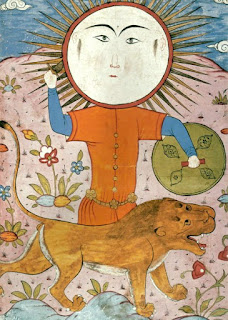
In Iranian heraldry, the royal line is symbolized by the lion and the solar disk. In the Torah, the lion symbolizes Israel and the reconciler — that is, the Moshiach.
Researchers note that the name Aaron most likely has ancient Egyptian origins, meaning “warrior-lion,” or it may be connected with the symbol Aaru (Iaru, Ialu) — the Paradise, the Field of Iaru, where the righteous attained eternal life and bliss after the judgment of Osiris. As we have already noted, the heavenly Paradise lies upon the “body” of Aran/Adam, which is Albania. Another name of Albania is Alu, the symbol of El. In Islam, the symbol Alu/El is known as Imam Ali, who is also called the Lion of Allah. In the sources, the followers of Imam Ali are regarded as Shi‘ites and Alevis. Their saints are called erens and nizars. The symbol of Eren is Aron. The Shi‘ites-Alevis call their erens “Hu-Eren” (Hu-Eren/Charon/Aharon), that is, Divine Eren (God-Eren). Thus, the symbols Aharon/Harun mean Divine Aron. And the Nizars are the Nazoreans, the Nazarenes. It follows that the Shi‘ites-Alevis are indeed the Levitical tribe, the Levites.
In Shi‘ite esotericism, the symbol Levi (LV) is identical to the symbol Wali (VL), meaning “saint.” And the symbol Levite in Sufi-Batini doctrine is deciphered as El-Vit (El-Bayt), that is, the Divine House of Ali, which also includes the Prophet Muhammad. This is the House of Wisdom of the saints — those who knew the mystery of creation, the “language of birds” of King Solomon. This science is also known as the “Ismaili Philosophy” of the Ismailis of Gelad. The Torah also speaks of the Ismailites of Gelad/Gilead. In Arabic sources, the Gelad Ismailis are considered extreme Shi‘ites and are called Ghulat-Shia. Their extremity points to their connection with the warriors of faith — the Levites.
According to the logic of the sages, the symbol Shia is identical to the symbol Yeshua, that is, Jesus. Hence, the extreme Gelad Shi‘ites of Aran are the Levite-Nazarenes of Galilee — that is, the Gelarkuni. Gelad, Gelarkuni, Gilan, and so on are different names of the one and same place where the Cosmic God-Man Adam/Atum was created. And the most ancient name of this land is the city of Gel, that is, Heliopolis (15).
In Sufism, the symbol of Levi is identical with the symbol of Alevi. The Alevis are also called Alevi Bektashi Erenleri. In Batini doctrine, this means “the holy descendants of Aaron, connected with the Divine Fire.” One must especially speak of the link between the Divine Fire and the Turkic beks. We have already noted that in the ecstatic state of the theurg, at the stage of Baqa, the spirit of the theurg unites with the prima materia, that is, with the Divine Fire, and begins to act in its name. It was precisely in this state that the theurg Amon created Adam, Paradise, and so on in the heavens.
Therefore, the symbol Bek is connected with the Divine Fire (Atesh), and the symbol Bektash means Bek-Atesh — the “Fire-Beks,” who in Iran are also called Ahli-Haqq, that is, “the People of Allah.” According to the sources, the Divine Fire of the beks is preserved 45 km from the city of Ardabil, on the land of the holy Kadus (Quds/Gades/Kades/Kodesh) — the Maru-Amorites of ancient Media (Madiama).
In ancient Turkey, the Alevis were also known as the Luvians, who were likewise called the “People of Light” (14). If we take into account that, according to the Torah, the heavenly humans were created in the image and likeness of God — that is, as the Cosmic Luminous Man — then it becomes clear that the Alevis are the descendants of the heavenly beings. All of this reveals that the Levi-Levites are indeed the Shi‘ites-Alevis, who are descendants of the Ismailite Turks of Gelad.
For five thousand years, the world was ruled by the divine dynasty of the Albanian kings of Gelar. These Azerbaijani Turkic beks were also noted in ancient sources as the Khazar (Hu-Azer) Turkic beks. During the time of the “Arab conquests,” the name Gelar transformed into Jalayir, and until the past century in Iran the Jalayirs-Qajars-Kadzhars (16) ruled. But in the early twentieth century, after the coup, the last shah of the divine Qajar lineage left the throne, and Iran came under the rule of a line of mere mortals. With this, the mysterious “language of birds” of the ancient philosopher-kings was forgotten.
From all this it follows that the Levites, whom God chose to serve Him, were in fact rulers of the world. Therefore Rabbi Shimon especially emphasized that all the sons of Israel are descendants of kings. And some of the Tannaim saw in Israel’s chosenness a cosmic act (17). In Sufi-Batini doctrine, this Cosmic Man is the Prophet Muhammad, who, according to al-Ghazali, is the heavenly man and is considered the Cosmic Force upon which the order and preservation of the universe depend (18). And the Islamic saints Wali (Awliya) — that is, the Tribe of Levi — are the collective type of this Perfect Cosmic Man.
Plato calls this Cosmic Adam — on whose “body” the Edenic Paradise appeared — the State. According to him, in order to rule the state, God created people with a mixture of gold and silver, whom he called philosopher-kings. The state will endure as long as these chosen ones remain in power — those whom Arabic sources call the golden-headed (Qizilbash) of Shah Ismail. Without them, the world cannot be delivered from misfortune.
References
1. Article «Расшифровка Торы с помощью «язык птиц»: С кем боролся Иаков», website: http://gilarbey.blogspot.com/2017/03/blog-post.html?m=1
2. Book «Книга Гора или расшифровка Торы», website: http://gilarbey.blogspot.com/2013/05/blog-post_8125.html?m=1
3. Bible, Deuteronomy 4:32
4. Article «Adəm və Həvva haqqında ağlasığmaz həqiqətlər», website: http://gilarbek.blogspot.com/2015/06/adm-v-hvva-haqqnda-aglasgmaz-hqiqtlr.html?m=1
5. Article «Что такое Каббала?», website: https://gilarbek.blogspot.com/2012/11/blog-post.html?m=1
6. Book «Красная Башня», website: http://www.gilarbeg.com/?sehife=oxu&lang=1&content=1193
7. Article «Истина об Израильском царстве», website: http://www.gilarbeg.com/?sehife=oxu&lang=1&content=1226
8. Bible, Deuteronomy 10:8–9
9. Article «Будда является единым Богом всех религий», website: http://gilarbey.blogspot.com/2013/09/blog-post.html
10. Article «Ledun elminin əsasları», website: http://gilarbey.blogspot.com/2013/03/ledun-elminin-saslar.html
11. Bible, Exodus 40:35
12. M. Khorensky, «История Армении», Book 1, Ch. 60
13. Book «Россия – страна Хазарских беков или о чём повествует «Книга Велеса», website: http://www.gilarbeg.com/?sehife=oxu&lang=&content=1162
14. Article «Işık insanları-Luviler-Aluviler», website: http://revolutionaryfire.com/index.php/using-joomla/extensions/components/content-component/article-categories/78-manset/slides/111-isik-insanlari-luviler-aluvile
15. Article «Основой всех религий является одно космическое событие», website: https://gilarbeg.wordpress.com/2020/05/08/%D0%BE%D1%81%D0%BD%D0%BE%D0%B2%D0%BE%D0%B9-%D0%B2%D1%81%D0%B5%D1%85-%D1%80%D0%B5%D0%BB%D0%B8%D0%B3%D0%B8%D0%B9-%D1%8F%D0%B2%D0%BB%D1%8F%D0%B5%D1%82%D1%81%D1%8F-%D0%BE%D0%B4%D0%BD%D0%BE-%D0%BA%D0%BE/
16. Article «Джалаиры – божественный род Геракла», website: http://gilarbey.blogspot.com/2018/04/blog-post.html?m=1
17. Urbach E. E. “Мудрецы Талмуда”. Israel. 1989, p. 277
18. Abu Hamid Al-Ghazali, «Воскрешение наук о вере», Moscow, 1980, p. 284
Firudin Gilar Bek
Комментарии
Отправить комментарий